Are you ready to outpace your competition and seize new growth in 2026’s rapidly evolving market? The landscape is shifting fast, with disruptive technologies and increasing rivalry challenging every business leader to think ahead.
This guide is your roadmap to mastering strategic marketing for the year ahead. You will discover proven strategies, frameworks, and actionable steps designed for breakthrough results. From the fundamentals and step-by-step process to emerging trends and real-world examples, each section delivers insights you can apply for measurable growth.
Gain a clear advantage by understanding how to align your marketing with business goals, boost ROI, and build lasting customer loyalty. Now is the time to adopt these strategies and unlock unstoppable success in 2026.
The Foundations of Strategic Marketing in 2026
Understanding Strategic Marketing
Strategic marketing is a disciplined, long-term approach that aligns every marketing activity with your broader business objectives. Unlike tactical marketing, which focuses on short-term campaigns or promotions, strategic marketing emphasizes planning, positioning, and sustainable growth.
This method relies on data-driven insights to answer critical questions: who are your ideal customers, what do they value, why should they choose you, and how will you deliver that value consistently? For instance, Improvado leverages systematic market research and detailed audience segmentation to ensure every move supports overall business goals.
By prioritizing foresight and alignment, strategic marketing lays the groundwork for true competitive advantage.

Core Components and Benefits
Every effective strategic marketing plan is built on several foundational components. These include comprehensive market research and analysis to spot new opportunities, customer segmentation and persona development to tailor outreach, and the creation of a unique value proposition that sets your business apart.
Strategic plan development and smart resource allocation ensure your efforts are both efficient and measurable. The benefits are significant:
- Sustainable competitive advantage
- Improved return on investment
- Consistent brand messaging
- Clear, measurable progress toward business goals
A key metric for any strategic marketing initiative is online visibility. If you are wondering whether your brand is reaching the right audience, resources like Can your customers find you online can help you assess and optimize your digital presence.
Strategic Marketing vs. Tactical Marketing vs. Marketing Strategy
Understanding the distinctions between these terms is crucial for success. Strategic marketing provides the long-term vision. Tactical marketing focuses on short-term execution. Marketing strategy acts as the bridge, connecting vision to action.
Here is a simple comparison:
| Aspect | Strategic Marketing | Tactical Marketing | Marketing Strategy |
|---|---|---|---|
| Focus | Long-term growth | Short-term actions | Connecting both |
| Example | Premium positioning | Launching a campaign | Mapping the journey |
| Time Horizon | 1–5 years | Weeks to months | 6–18 months |
According to Improvado, 70% of top-performing organizations credit their success to strong strategy alignment. Strategic marketing ensures every tactic is purposeful and supports your core business vision.
Why Strategic Marketing Matters in 2026
The marketing landscape in 2026 is shaped by accelerating AI advancements, digital transformation, and rapidly shifting consumer behaviors. Businesses can no longer afford to react to change; they must proactively adapt with strategic marketing at the core.
Leading institutions like Harvard Business School emphasize the need for strategic agility and robust digital ecosystems. Organizations that build their foundation on strategic marketing consistently outperform competitors in both growth and resilience.
By staying ahead of disruptions and focusing on long-term value creation, strategic marketing empowers brands to thrive, not just survive, in the evolving marketplace.
The 5-Step Strategic Marketing Process for 2026
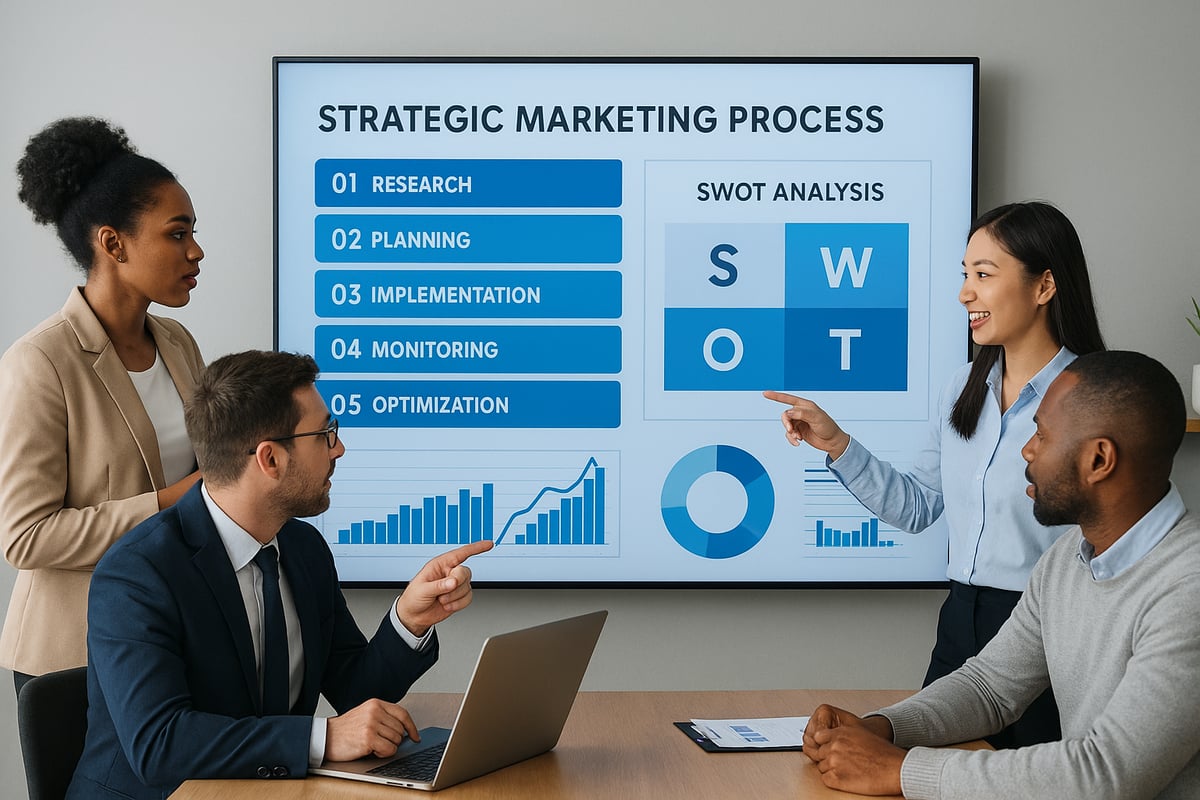
Staying ahead in 2026 demands a clear, structured approach to strategic marketing. The 5-step process below ensures your marketing efforts are aligned with business goals, data-driven, and agile enough to adapt to ongoing market shifts. Each step is designed to build on the previous, guiding your team from analysis to execution with measurable impact.
Step 1: Situational Analysis & SWOT
Begin your strategic marketing journey with a thorough situational analysis. Evaluate both internal and external factors to understand your organization's strengths, weaknesses, opportunities, and threats.
Use frameworks such as SWOT and PESTEL to map the broader environment, including political, economic, social, technological, environmental, and legal trends. This holistic approach uncovers hidden risks and areas for growth.
For example, a technology company may leverage its advanced R&D capabilities to counteract emerging market threats, ensuring resilience. According to Improvado, 85 percent of successful strategies start with deep situational analysis, highlighting its foundational role.
A well-executed situational analysis empowers your team to answer key strategic marketing questions: Where do we stand, and what forces shape our future? This step is vital for making informed decisions as you move forward.
Step 2: Market Research & Customer Analysis
Once you have a clear understanding of your environment, shift focus to market research and customer analysis. Gather quantitative data through surveys and analytics, and complement it with qualitative insights from interviews or focus groups.
Segment audiences using demographics, behaviors, and psychographics. This allows for highly targeted strategic marketing initiatives that resonate with specific customer needs and preferences.
Analyze market size, growth potential, and trends to prioritize opportunities. Harvard’s programs emphasize the importance of understanding buying behaviors and customer motivations, which drives effective segmentation.
By deeply knowing your customers, you can tailor your offerings and messaging, maximizing engagement and conversion rates. In 2026, customer-centric strategic marketing will be the key to unlocking new growth.
Step 3: Strategy Formulation & Positioning
With research in hand, the next step is to formulate your strategy and define your market positioning. Select priority segments based on their attractiveness and alignment with your business strengths.
Develop a unique value proposition that differentiates your brand in the marketplace. Competitive positioning is critical for standing out amid increasing competition. For instance, a brand might reposition itself to attract an emerging demographic, capturing new market share.
Data from Improvado shows that organizations with clear positioning achieve 33 percent higher market share growth. Strategic marketing at this stage means making deliberate choices about where to compete and how to win.
A robust positioning statement guides all communication and campaign decisions, ensuring coherence and effectiveness across every channel.
Step 4: Strategic Planning & Marketing Mix Optimization
Strategic planning translates your strategy into actionable objectives. Set SMART goals—specific, measurable, achievable, relevant, and time-bound—that align with your overall business vision.
Optimize the classic 4Ps: Product, Price, Place, and Promotion. Tailor each element for your chosen segments to maximize impact. Allocate resources to high-impact initiatives, ensuring budget efficiency and adaptability.
Integrated digital campaigns are essential for an omnichannel presence in 2026. Use data-driven insights and tools, such as real-time dashboards, for agile adjustments and optimization. For a deeper look at how these trends are evolving, explore this blog on marketing strategies, which offers case studies and ongoing updates relevant to strategic marketing.
Effective planning and optimization ensure your strategic marketing efforts deliver measurable results, adapting quickly to changes in the market landscape.
Step 5: Implementation & Performance Measurement
The final step is to put your plan into action and measure performance rigorously. Assign clear responsibilities, set timelines, and develop actionable plans for each initiative.
Use key performance indicators (KPIs) and analytics platforms to track progress in real time. Tools like dashboards and UTM tracking enable you to monitor campaigns and pivot as needed.
Agile marketing teams leverage these insights to make continuous improvements. Improvado’s real-time analytics, for example, empower marketers to iterate rapidly and respond to market feedback.
In 2026, organizations that excel at implementation and measurement will see higher returns and sustained growth. Strategic marketing is not static; ongoing optimization is crucial for long-term success.
Emerging Trends Shaping Strategic Marketing in 2026
The landscape of strategic marketing in 2026 is rapidly evolving. New technologies, shifting consumer expectations, and global market forces are shaping the way organizations compete and grow. Staying ahead means understanding and adapting to the trends that will define the future.

The Rise of AI and Automation
AI and automation are redefining what is possible in strategic marketing. Marketers now use AI-driven analytics for deeper customer insights and predictive modeling, allowing them to anticipate market shifts with precision.
Automation streamlines campaign management, enabling real time personalization and faster reporting. For example, generative AI tools are transforming content creation, freeing teams to focus on strategy and creativity. According to recent data, 60% of marketers plan to increase AI investments in 2026, underlining its central role.
For a detailed look at how AI is moving from efficiency to effectiveness in marketing, see AI’s Impact on 2026 Marketing Trends.
Omnichannel Customer Experiences
Delivering seamless omnichannel experiences is now a core expectation. Strategic marketing in 2026 requires integrating digital, social, and physical touchpoints to create a unified brand presence.
Brands use customer data to personalize interactions across channels. For instance, retailers are blending online and in store data to anticipate needs and enhance engagement. Consistent messaging and a cohesive journey drive loyalty.
Research shows omnichannel strategies lead to 23% higher customer retention rates. This trend highlights the importance of strategic marketing in building lasting relationships.
Data-Driven Decision Making and Analytics
Data is the backbone of effective strategic marketing. Real time dashboards allow marketers to monitor performance and pivot quickly when necessary.
Advanced attribution models help allocate resources more effectively by revealing which channels deliver the best ROI. Automated reporting tools, such as those from Improvado, deliver actionable insights that support agile decision making.
Data backed decisions give organizations a measurable edge. In 2026, intuition alone is not enough. Strategic marketing relies on analytics to maximize every opportunity.
Purpose-Driven and Value-Based Branding
Consumers expect brands to stand for something beyond products or services. Strategic marketing in 2026 centers on authentic, purpose driven messaging that aligns with customer values.
Brands that communicate transparency and social responsibility build trust and loyalty. Recent studies reveal that 76% of consumers prefer brands that reflect their beliefs and ethics.
Companies are evolving campaigns to resonate with shifting values, using strategic marketing to differentiate in crowded markets.
Navigating Market Disruption and Digital Transformation
Market disruption is constant. Strategic marketing equips organizations to adapt to new technologies, regulations, and competitors.
Building flexible digital ecosystems and developing strategic agility are essential. Harvard’s focus on innovation and continuous learning demonstrates how proactive adaptation fuels resilience.
Organizations that embrace digital transformation and keep evolving their strategic marketing approach are best positioned for long term relevance and growth.
Building a Winning Strategic Marketing Plan
Developing a winning strategic marketing plan in 2026 requires a structured approach, clear vision, and a commitment to continuous improvement. Each component of your plan must work together to drive measurable results, foster customer loyalty, and ensure long-term growth. Let us explore the core building blocks that set leading organizations apart.

Setting Clear Objectives and KPIs
The first step in any strategic marketing initiative is to align your marketing objectives with the broader business vision. Clear, measurable KPIs allow organizations to track progress, optimize efforts, and demonstrate ROI.
Consider using SMART goals to define your targets. For example:
Increase market share by 15 percent within 12 months by acquiring 2,000 new customers in the target segment.
A structured table helps clarify objectives and KPIs:
| Objective | KPI | Target |
|---|---|---|
| Grow brand awareness | Website traffic | +25 percent |
| Boost customer engagement | Social media interactions | +40 percent |
| Improve conversion rates | Lead-to-sale ratio | 18 percent |
Organizations that set clear KPIs as part of their strategic marketing plan are twice as likely to achieve their targets.
Deep Customer Segmentation and Persona Development
Effective strategic marketing pivots on understanding your audience at a granular level. Begin by segmenting your market based on key criteria such as demographics, behaviors, and psychographics.
Develop detailed buyer personas for each segment. Include:
- Age, gender, occupation, and location
- Motivations, pain points, and goals
- Preferred communication channels
For example, a B2B persona may prioritize efficiency and ROI, while a B2C persona values brand experience and trust. Tailoring your messaging and offers to these personas ensures that every campaign resonates with its intended audience.
Investing in deep segmentation as part of your strategic marketing approach drives more personalized outreach and higher engagement rates.
Crafting a Compelling Value Proposition
A strong value proposition is the cornerstone of strategic marketing success. It clearly articulates why your solution is unique and how it addresses customer needs better than the competition.
To craft a compelling value proposition:
- Identify the core benefit your product or service delivers
- Highlight differentiators that set you apart
- Use customer-centric language
Consider this example:
Our platform streamlines workflow for busy teams, saving an average of 10 hours per month, so you can focus on growth.
Brands that excel in defining and communicating their value proposition as part of strategic marketing consistently outperform their peers.
Integrating Digital and Traditional Channels
A holistic strategic marketing plan blends digital and traditional channels to create a seamless customer journey. From SEO and content marketing to print and event sponsorships, optimizing the mix ensures broad reach and consistent messaging.
Omnichannel strategies leverage data to personalize every touchpoint. For emerging channel opportunities, review Emerging Marketing Channels in 2026, which highlights the convergence of entertainment, social, and commerce.
Best practices include:
- Mapping customer journeys across channels
- Maintaining unified brand voice
- Measuring channel effectiveness with analytics
This integrated approach is essential for strategic marketing excellence in 2026.
Resource Allocation and Budgeting
Resource allocation is pivotal in strategic marketing planning. Prioritize channels and campaigns based on data-driven insights, focusing on those with the highest impact and ROI.
Effective budgeting includes:
- Allocating funds for both proven and experimental initiatives
- Adjusting budgets dynamically based on performance analytics
- Ensuring resources are available for technology, talent, and training
For example, shifting budget from underperforming ads to high-converting channels maximizes return. Strategic marketing teams that master resource allocation are better positioned to adapt and thrive in a fast-changing market.
Performance Tracking and Continuous Optimization
Continuous performance monitoring is the heartbeat of strategic marketing. Implement real-time dashboards and UTM tracking to measure campaign effectiveness and guide decisions.
Key steps include:
- Defining relevant metrics for each objective
- Setting up automated reporting systems
- Using insights to refine tactics and pivot quickly
Organizations that embrace ongoing optimization in their strategic marketing process see up to 30 percent higher ROI. Make performance tracking a daily habit to ensure long-term success.
Real-World Examples and Industry Case Studies
Understanding how strategic marketing drives real results begins with a look at industry leaders and agile innovators. Their journeys illustrate how the right approach can transform growth, resilience, and market share. Let us explore how brands, disruptors, and teams are harnessing strategic marketing to excel in 2026.
Success Stories from Leading Brands
Leading global brands such as Meta, Unilever, Google, and Samsung exemplify the power of strategic marketing. These companies integrate data-driven decision making with innovation and customer-centricity. For instance, Meta leverages advanced analytics to refine audience targeting, while Unilever adapts its messaging to evolving consumer values.
Vanguard’s European marketing transformation is a prime example. By aligning their teams around clear objectives, embracing omnichannel strategies, and investing in advanced analytics, Vanguard increased both reach and engagement. Many organizations benefit from working with experts, as highlighted in content marketing companies insights, which reviews top partners for executing sophisticated strategic marketing plans.
Lessons from Market Disruptors
Startups and agile brands often outmaneuver larger competitors by embracing rapid iteration and targeted strategies. These disruptors use strategic marketing to identify niche opportunities and scale quickly. For example, tech startups frequently rely on AI-powered analytics and personalized outreach to build loyal customer bases.
A recent case study on AI in Marketing Mix Modeling demonstrates how advanced machine learning enables precise budget allocation and campaign optimization. By leveraging such tools, disruptors can adjust their strategic marketing efforts in real time, seizing market opportunities before incumbents can react.
Overcoming Common Strategic Marketing Challenges
Even the best teams encounter hurdles when implementing strategic marketing. Common barriers include limited resources, fragmented data, and market uncertainty. To address these issues, leading organizations break down silos and promote cross-functional alignment between marketing, sales, and product development.
Integrated analytics platforms help teams gain a unified view of performance, enabling proactive planning and agile pivots. For example, Improvado’s end-to-end data pipeline empowers marketing teams to streamline reporting and optimize campaigns. Choosing the right partners, as discussed in content marketing companies insights, also supports efficient execution of strategic marketing initiatives.
Key Takeaways and Action Steps for 2026
To win with strategic marketing in 2026, focus on agility, customer insight, and measurable outcomes. Begin by setting clear objectives and KPIs aligned with your business vision. Build detailed personas and tailor your value proposition to stand out in a crowded market.
Use both digital and traditional channels to reach your audience, and prioritize ongoing optimization based on analytics. Finally, foster cross-functional collaboration and continuous learning. These steps will help your organization build a resilient, high-performing strategic marketing engine ready for the challenges and opportunities of 2026.
Expert Tips and Resources for Strategic Marketing Excellence
Mastering strategic marketing in 2026 requires more than theory. It demands proven frameworks, agile leadership, empowered teams, and ongoing learning. Use these expert tips and resources to elevate your approach, drive measurable results, and stay ahead in an ever-evolving marketplace.
Proven Frameworks and Tools for 2026
Successful strategic marketing starts with the right frameworks and tools. Industry leaders rely on methods like SWOT and PESTEL for analyzing environments, plus customer journey mapping to understand every touchpoint. Marketing mix modeling and real-time dashboards power smarter decisions and track impact efficiently.
Popular Frameworks and Tools:
| Framework/Tool | Purpose |
|---|---|
| SWOT | Internal/external analysis |
| PESTEL | Macro-environmental scanning |
| Customer Journey Map | Visualize customer experience |
| Marketing Mix Modeling | Optimize 4Ps for target segments |
| Analytics Dashboards | Real-time performance tracking |
Platforms like Improvado deliver automated analytics, while Harvard’s case method offers practical learning. For insights on the latest automation and AI trends shaping strategic marketing, explore the 2026 Marketing Strategy Trends report.
Developing Strategic Agility and Leadership
Strategic marketing excellence depends on agile, visionary leadership. Cultivating a culture of innovation, collaboration, and data-driven thinking keeps organizations resilient through change. Invest in executive education to sharpen skills for navigating uncertainty and harnessing new opportunities.
Harvard Business School’s programs for senior marketers focus on building strategic agility, empowering leaders to pivot strategies as markets shift. Encourage open communication and risk-taking, fostering a growth mindset across your marketing team.
Embrace continuous learning. Effective leaders in strategic marketing set the tone for adaptability, ensuring their organizations can respond quickly to disruption.
Empowering Your Team for Success
Empowered teams turn strategy into action. Align marketing, sales, and product groups to break down silos and streamline execution. Cross-functional collaboration ensures every initiative supports shared business objectives and maximizes strategic marketing impact.
Facilitate regular feedback loops and knowledge sharing. Harvard’s collaborative cohorts and learning groups are excellent models, encouraging peer-to-peer support and ongoing development.
Provide access to the latest tools and training. When teams are equipped and motivated, strategic marketing initiatives deliver stronger results with greater consistency.
Additional Learning and Networking Opportunities
Continuous growth in strategic marketing relies on expanding your knowledge and connections. Attend industry conferences to stay informed about cutting-edge trends. Enroll in executive education programs to deepen expertise and gain fresh perspectives.
Engage with alumni networks and thought leaders for real-world insights. Harvard Business School’s global cohorts and alumni stories offer valuable lessons and inspiration for marketers at every level.
Seek out online resources, webinars, and professional groups. Building a diverse network supports your strategic marketing journey and opens doors to new opportunities.
As you look to apply these strategic marketing insights and set your business up for real growth in 2026, it’s important to know exactly where you stand in the digital landscape. That’s why I recommend taking the next step and getting a clear, data-driven snapshot of your current marketing visibility. With the right perspective, you can prioritize what matters most and make smarter decisions for your business. Ready to see where your opportunities lie? Claim your Free Visibility Snapshot and start building the roadmap to measurable success.