
Building a successful business in 2026 requires more than just a great product or service. It demands a comprehensive online marketing strategy that connects your brand with the right audience at the right time. Whether you're a startup founder or an established business leader, understanding how to leverage digital channels effectively can mean the difference between stagnant growth and exponential success. The landscape of digital marketing continues to evolve, presenting both challenges and opportunities for businesses ready to adapt and innovate.
Understanding the Foundation of Online Marketing Strategy
An online marketing strategy serves as your roadmap for achieving business objectives through digital channels. Unlike traditional marketing, digital platforms offer unprecedented opportunities to track, measure, and optimize every aspect of your campaigns in real time.
The most effective strategies begin with clear goal-setting. Are you looking to increase brand awareness, generate qualified leads, or drive direct sales? Your objectives will determine which channels and tactics deserve the most attention and budget allocation.
Defining Your Target Audience
Understanding your ideal customer is non-negotiable. Before investing in any marketing channel, develop detailed buyer personas that include:
- Demographic information (age, location, income, job title)
- Pain points and challenges they face
- Preferred communication channels and content formats
- Buying behaviors and decision-making processes
- Goals and aspirations related to your offering
Research from comprehensive digital marketing studies demonstrates that businesses with clearly defined audiences achieve significantly higher conversion rates than those using generic targeting approaches.

Building Your Multi-Channel Approach
A robust online marketing strategy never relies on a single channel. The most successful businesses integrate multiple touchpoints to create a cohesive customer journey.
Search Engine Optimization as Your Foundation
SEO remains one of the most cost-effective long-term investments in digital marketing. When you rank organically for relevant search terms, you capture prospects actively looking for solutions you provide.
Key SEO priorities for 2026 include:
- Technical optimization ensuring fast load times and mobile responsiveness
- High-quality content that answers specific user questions
- Strategic internal linking to distribute page authority
- Authoritative backlinks from reputable industry sources
- Local SEO optimization for location-based businesses
Understanding Page Authority and how it impacts rankings helps you prioritize which pages to optimize first. For businesses seeking to establish credibility, implementing strategies for building online authority should be a top priority.
Mountain Mover Coaching and Digital Marketing helps businesses implement comprehensive SEO strategies that drive measurable organic traffic growth.
Content Marketing That Converts
Content serves as the fuel for your entire online marketing strategy. Without valuable, relevant content, your social media profiles remain empty, your email campaigns lack substance, and your SEO efforts fall flat.
| Content Type | Primary Benefit | Best For |
|---|---|---|
| Blog Articles | SEO traffic, thought leadership | Top-of-funnel awareness |
| Video Content | Engagement, explanation | Product demos, testimonials |
| Case Studies | Trust building, proof | Bottom-of-funnel conversion |
| Infographics | Social sharing, simplification | Complex data visualization |
| Podcasts | Authority, relationship building | Audience nurturing |
Video content deserves special attention in 2026. Platforms like Viva Media specialize in creating high-performance video content that delivers measurable business results, while services like beCreatives offer unlimited video editing to help businesses maintain consistent video output without overwhelming internal resources.
The key is matching content formats to audience preferences and campaign objectives. A software company might prioritize tutorial videos and technical blog posts, while a coaching business might focus on podcasts and LinkedIn articles.
Leveraging Paid Advertising for Immediate Results
While organic strategies build long-term value, paid advertising delivers immediate visibility and traffic. The most effective online marketing strategy balances both approaches strategically.
Pay-Per-Click Advertising Fundamentals
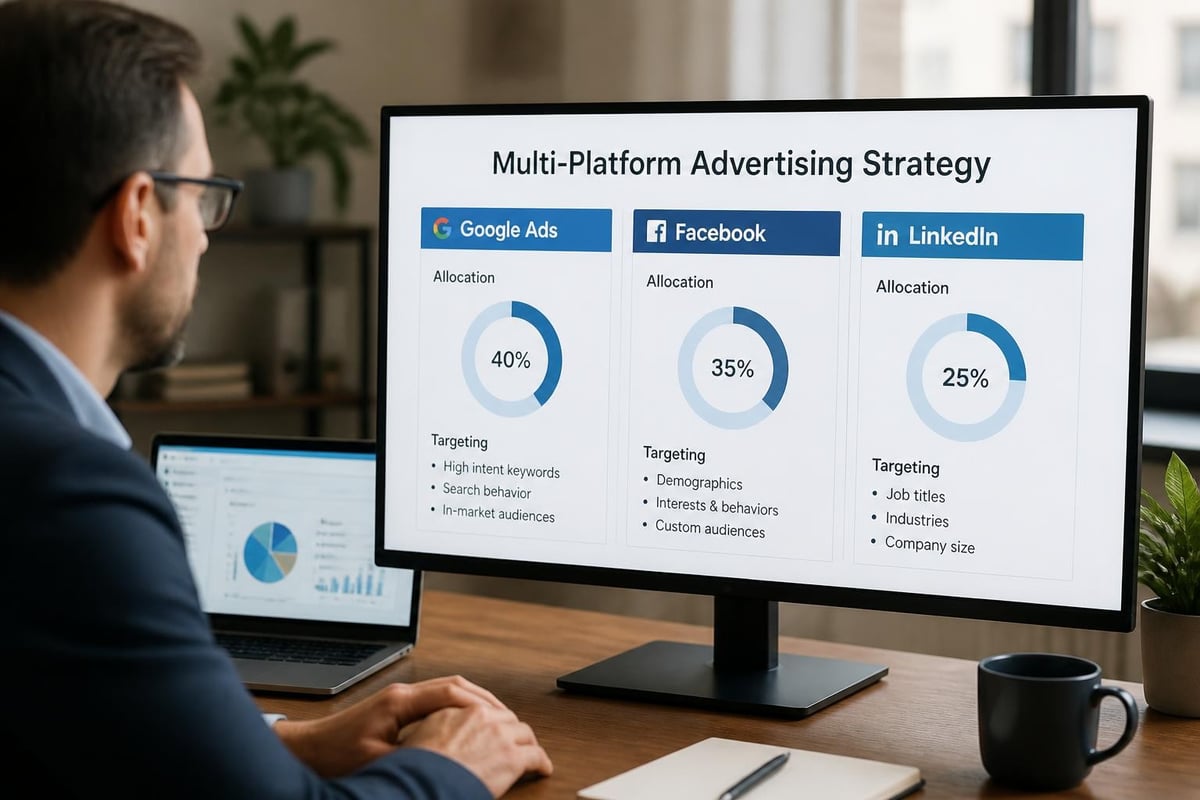
PPC campaigns allow you to appear instantly in front of qualified prospects. Google Ads, Facebook Ads, and LinkedIn Ads each serve distinct purposes within your overall strategy.
Google Ads excels at capturing high-intent searches. When someone searches "digital marketing agency near me," a well-optimized ad can connect them directly with your services. Google AdWords management requires ongoing optimization to maintain profitability as competition and costs fluctuate.
Social media advertising works differently. Rather than capturing existing demand, these platforms excel at creating demand through targeted outreach. You can reach specific audiences based on interests, behaviors, job titles, and countless other criteria.
Critical PPC success factors include:
- Precise audience targeting to minimize wasted spend
- Compelling ad copy that speaks to specific pain points
- Optimized landing pages aligned with ad messaging
- Conversion tracking to measure actual ROI
- Regular A/B testing of ad variations and targeting parameters
For businesses exploring PPC advertising options, starting with smaller budgets and scaling winners provides the most capital-efficient approach.
Social Media Strategy Beyond Posting
Social media marketing has matured far beyond simply posting updates. An effective online marketing strategy treats social platforms as relationship-building and conversion tools, not just broadcasting channels.
Platform Selection and Optimization
Not every platform deserves your attention. Focus on channels where your target audience actively engages, rather than spreading resources across every available network.
B2B companies typically find LinkedIn and Twitter most valuable for reaching decision-makers. E-commerce brands often thrive on Instagram and Pinterest. Local service businesses may achieve better results with Facebook and Google Business Profile optimization.
Consistency matters more than frequency. Three high-quality posts per week outperform daily low-effort content. Each post should serve a strategic purpose:
- Educational content positions you as an industry authority
- Behind-the-scenes content builds personal connection and trust
- Customer success stories provide social proof
- Promotional content drives specific actions (when used sparingly)
The rise of short-form video across platforms has created new opportunities. TikTok, Instagram Reels, and YouTube Shorts allow businesses to reach massive audiences with creative, engaging content.
Email Marketing as Your Direct Line
Despite predictions of its demise, email marketing remains one of the highest-ROI channels in any online marketing strategy. It provides direct access to your audience without algorithm interference.
Building and Nurturing Your List
Growing an email list requires offering genuine value in exchange for contact information. Lead magnets might include:
- Industry-specific templates or tools
- Comprehensive guides or ebooks
- Exclusive video training series
- Free consultations or audits
- Early access to new products or content
Once subscribers join your list, segmentation allows you to send highly relevant messages. A coaching business might segment by industry, company size, or specific challenges. An agency might segment by services of interest or stage in the buyer journey.
Automation transforms email marketing efficiency. Welcome sequences introduce new subscribers to your brand. Abandoned cart sequences recover lost sales. Re-engagement campaigns win back inactive subscribers.
For entrepreneurs building digital businesses, platforms like CreateSell provide comprehensive guidance on turning knowledge into automated digital products that generate passive income through strategic email marketing.
Data-Driven Decision Making
The difference between average and exceptional online marketing strategy often comes down to measurement and optimization. Every tactic should connect to measurable outcomes.
Essential Metrics to Track
| Metric Category | Key Indicators | What They Reveal |
|---|---|---|
| Traffic | Sessions, users, sources | Audience reach and acquisition effectiveness |
| Engagement | Bounce rate, time on page, pages per session | Content quality and relevance |
| Conversion | Form submissions, purchases, sign-ups | Campaign effectiveness and ROI |
| Revenue | Customer lifetime value, cost per acquisition | Business impact and profitability |
Google Analytics provides foundational tracking, but comprehensive strategies often require additional tools for heat mapping, call tracking, and attribution modeling.
Marketing statistics and research help benchmark your performance against industry standards. However, the most important comparison is against your own historical data. Are you improving month over month?

Integration and Consistency Across Channels
An online marketing strategy succeeds when all channels work together harmoniously. Your blog content feeds social media posts. Your social engagement drives email subscriptions. Your email campaigns support paid advertising retargeting.
Creating a Unified Brand Experience
Consistency in messaging, visual identity, and value proposition across all touchpoints builds recognition and trust. When a prospect sees your LinkedIn post, visits your website, and receives your email, each interaction should feel cohesive.
Brand guidelines should cover:
- Voice and tone across different contexts
- Visual elements including colors, fonts, and imagery
- Key messaging points and value propositions
- Customer service and communication standards
Technology integration streamlines execution. CRM systems connect with email platforms, which integrate with advertising accounts, creating a unified view of customer interactions. This integration enables sophisticated tactics like retargeting website visitors with specific ads based on pages viewed.
Staying Current with Evolving Trends
Digital marketing evolves rapidly. What worked exceptionally well in 2024 may deliver diminishing returns in 2026. Successful businesses remain adaptable and continuously test new approaches.
Emerging Opportunities to Explore
Artificial intelligence now powers everything from content creation to predictive analytics. Resources on using AI responsibly in marketing help businesses leverage these capabilities ethically and effectively.
Privacy changes continue reshaping data collection and targeting capabilities. Third-party cookie deprecation requires first-party data strategies and contextual targeting approaches.
Voice search optimization grows increasingly important as smart speakers and voice assistants proliferate. Optimizing for conversational queries differs significantly from traditional keyword targeting.
Testing should be systematic, not random. Develop hypotheses, implement controlled tests, measure results objectively, and scale winners while eliminating losers. This scientific approach to optimization compounds improvements over time.
Scaling What Works
Once you identify profitable channels and tactics, scaling becomes the priority. However, scaling requires maintaining quality while increasing volume, which presents unique challenges.
Resource Allocation for Growth
As campaigns expand, resource constraints often become the bottleneck. Hiring, training, or outsourcing becomes necessary to maintain execution quality.
Many businesses find strategic partnerships valuable for specialized capabilities. Rather than building in-house video production capacity, partnering with experts allows you to scale that content type without massive capital investment.
Budget allocation should follow performance data. If organic search delivers a $10 customer acquisition cost while paid social costs $50, shifting budget toward SEO makes financial sense, assuming you can scale that channel without dramatically increasing costs.
Automation tools handle repetitive tasks including social media scheduling, email sequences, reporting, and basic customer interactions through chatbots. This frees human resources for strategic thinking and creative work that truly differentiates your brand.
Competitive Analysis and Differentiation
Understanding competitor strategies provides valuable insights without simply copying their approach. Your online marketing strategy should highlight what makes your business uniquely valuable.
Competitor analysis reveals gaps in the market. Perhaps competitors neglect certain content topics, ignore specific platforms, or fail to address particular customer concerns. These gaps represent opportunities for differentiation.
Tools for analyzing competitor keywords, backlinks, and advertising strategies provide quantitative data. Following their social accounts and subscribing to their emails reveals qualitative insights about messaging and positioning.
The goal is not imitation but informed innovation. Use competitive intelligence to make better strategic decisions while maintaining your authentic brand voice and unique value proposition.
An effective online marketing strategy combines multiple channels, consistent execution, and data-driven optimization to create sustainable business growth. The fundamentals outlined here provide a framework for building campaigns that attract qualified prospects, nurture relationships, and convert customers at scale. Whether you're refining an existing approach or building from scratch, Mountain Mover Coaching and Digital Marketing specializes in transforming businesses through strategic marketing, expert coaching, and measurable results that drive real growth for leaders ready to scale their impact.