
Google digital marketing has fundamentally transformed how businesses connect with their target audiences, offering an extensive ecosystem of tools that drive measurable results. From small startups to established enterprises, companies worldwide leverage Google's powerful platforms to increase visibility, attract qualified leads, and accelerate revenue growth. Understanding how to strategically implement these tools separates businesses that struggle from those that thrive in today's competitive digital landscape. The integration of artificial intelligence and machine learning into Google's marketing platforms has created unprecedented opportunities for businesses to optimize campaigns and achieve higher returns on investment.
Understanding the Google Digital Marketing Ecosystem
The foundation of successful google digital marketing begins with recognizing the interconnected nature of Google's platform offerings. Each tool serves a specific purpose while seamlessly integrating with others to create a comprehensive marketing strategy.
Google's primary marketing platforms include:
- Google Ads for paid search and display advertising
- Google Analytics for website traffic analysis and user behavior tracking
- Google Search Console for organic search performance monitoring
- Google My Business for local visibility and customer engagement
- YouTube for video marketing and brand storytelling
These platforms work together to provide businesses with complete visibility across the customer journey. When properly configured, data flows between systems, enabling marketers to understand which channels drive the most valuable traffic and conversions. This integrated approach distinguishes Google's offerings from standalone marketing tools that operate in isolation.
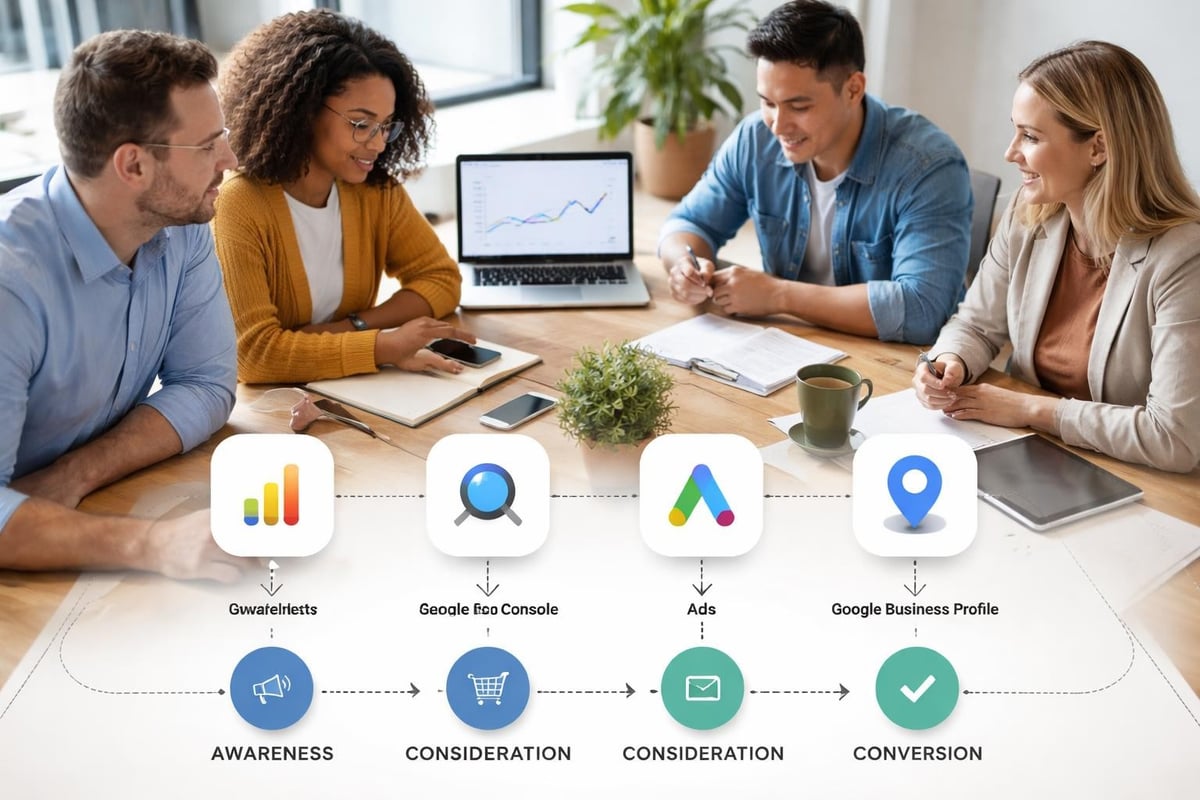
Understanding what digital marketing encompasses provides essential context for businesses beginning their journey. The evolution from traditional advertising to data-driven digital strategies represents a fundamental shift in how companies allocate marketing resources and measure success.
Leveraging Google Ads for Immediate Results
Google Ads remains the cornerstone of paid google digital marketing campaigns, delivering targeted traffic through search, display, video, shopping, and app promotion formats. The platform operates on a pay-per-click model, ensuring businesses only invest when potential customers demonstrate active interest.
Search campaigns capture high-intent users actively looking for specific products or services. Display campaigns build brand awareness across Google's vast network of partner websites. Video campaigns on YouTube engage audiences through compelling visual storytelling. Shopping campaigns showcase products directly in search results with images, prices, and merchant information.
| Campaign Type | Best For | Average CTR | Conversion Intent |
|---|---|---|---|
| Search Ads | High-intent keywords | 3-5% | Very High |
| Display Ads | Brand awareness | 0.5-1% | Low to Medium |
| Video Ads | Engagement and storytelling | 0.4-0.6% | Medium |
| Shopping Ads | E-commerce products | 0.9-1.3% | High |
Successful campaigns require meticulous keyword research, compelling ad copy, and strategic bid management. Quality Score, Google's metric for ad relevance and landing page experience, directly impacts both ad position and cost-per-click. Higher Quality Scores translate to lower costs and better placement, making continuous optimization essential for maximizing return on ad spend.
Top online marketing services demonstrate how Google Ads compares to alternative platforms, highlighting its unique advantages in reach and targeting precision. Businesses implementing strategic digital marketing approaches consistently outperform competitors who treat advertising as a one-time effort rather than an ongoing optimization process.
Mastering Search Engine Optimization Through Google Tools
Organic search visibility represents a critical component of comprehensive google digital marketing strategies. While paid advertising delivers immediate results, SEO builds sustainable long-term traffic that doesn't require ongoing advertising investment for each visitor.
Google Search Console serves as the primary tool for monitoring organic search performance. This free platform reveals which keywords drive traffic, identifies technical issues affecting visibility, and provides insights into how Google's algorithms interpret website content. Regular monitoring enables quick identification and resolution of crawling errors, mobile usability problems, and security issues that could harm search rankings.
Technical SEO Fundamentals
The technical foundation of website optimization directly impacts how effectively Google can crawl, index, and rank content. Site speed affects both user experience and search rankings, with Google explicitly incorporating page load times into ranking algorithms. Mobile responsiveness has become non-negotiable, as mobile-first indexing means Google primarily uses the mobile version of content for ranking purposes.
Critical technical elements include:
- XML sitemap submission ensuring Google discovers all important pages
- Robots.txt configuration guiding crawlers to prioritize valuable content
- Structured data markup helping Google understand content context and display rich results
- HTTPS security protecting user data and meeting Google's security requirements
- Core Web Vitals optimization delivering fast, stable, and interactive page experiences
Businesses partnering with experts who understand these technical requirements gain significant competitive advantages. Services like those offered by Empixa integrate strategic branding with technical optimization, ensuring websites not only attract visitors but convert them into customers through compelling user experiences.

Content Strategy and Keyword Optimization
Content remains the primary vehicle through which businesses demonstrate expertise and capture search traffic. Effective google digital marketing requires developing content that simultaneously serves user intent and incorporates strategic keywords naturally throughout the text.
Keyword research tools within Google Ads provide valuable insights into search volume, competition levels, and related terms. Understanding search intent determines whether users seek informational content, comparison resources, or immediate purchasing options. Aligning content format with intent maximizes relevance and conversion potential.
Long-form comprehensive content typically outperforms thin, superficial articles. Google's algorithms increasingly prioritize expertise, authoritativeness, and trustworthiness, particularly for topics that could impact reader health, finances, or safety. Demonstrating genuine subject matter knowledge through detailed explanations, original research, and practical examples establishes credibility that drives rankings and conversions.
Harnessing Analytics for Data-Driven Decisions
Google Analytics transforms raw website traffic data into actionable business intelligence. Understanding which marketing channels drive the most valuable visitors, which pages convert at the highest rates, and where users abandon the conversion process enables continuous improvement of marketing performance.
Key metrics every business should monitor:
- Traffic sources revealing which channels deliver the highest volume and quality visitors
- Bounce rate indicating whether landing pages meet visitor expectations
- Average session duration measuring engagement levels across different content types
- Conversion rate tracking the percentage of visitors completing desired actions
- Customer acquisition cost determining the efficiency of different marketing investments
Advanced segmentation capabilities allow marketers to analyze specific audience subsets, comparing behavior patterns between new and returning visitors, different geographic regions, or various device types. These insights inform budget allocation decisions, ensuring marketing resources focus on the highest-performing channels and audiences.
Recent developments in AI-powered tools are transforming how businesses approach google digital marketing analytics. Google has introduced AI capabilities to combat spam and scam ads, demonstrating the company's commitment to maintaining advertising quality and protecting legitimate businesses from fraudulent competition.
Implementing Local SEO for Geographic Targeting
Google My Business has become essential for businesses serving specific geographic markets. This free tool enables companies to manage how they appear in local search results and Google Maps, directly influencing whether nearby customers discover and choose their services.
Complete and accurate business profiles include business name, address, phone number, website, hours of operation, service categories, and high-quality photos. Regular updates through posts, offers, and events keep profiles active and engaging. Encouraging satisfied customers to leave reviews builds social proof while signaling quality to both potential customers and Google's ranking algorithms.
| Local Ranking Factor | Importance | Optimization Strategy |
|---|---|---|
| Google My Business completeness | High | Fill all fields, add photos, update hours |
| Review quantity and quality | Very High | Request reviews, respond professionally |
| Citation consistency | Medium | Ensure NAP matches across directories |
| Website location content | Medium | Create location-specific pages |
| Backlink profile | High | Build local partnerships and sponsorships |
Local pack rankings, which display businesses in map results for location-based searches, prioritize proximity, relevance, and prominence. While proximity depends on the searcher's location, businesses control relevance through accurate categorization and comprehensive profile information. Prominence stems from overall online reputation, including reviews, citations, and website authority.
Businesses implementing comprehensive local digital marketing strategies consistently outperform competitors with incomplete or neglected profiles. The difference often determines whether potential customers even see a business as an option.
Video Marketing Through YouTube Integration
YouTube represents the second-largest search engine globally, making video content a critical component of comprehensive google digital marketing strategies. Video marketing builds emotional connections, demonstrates products or services in action, and appeals to audiences who prefer visual content over written articles.

Educational content positions businesses as industry experts while capturing traffic from users researching solutions. Product demonstrations reduce purchase hesitation by showing exactly how offerings work and what results customers can expect. Customer testimonials provide authentic social proof that builds trust with prospective clients.
Optimizing Video Content for Discovery
Video SEO requires optimizing multiple elements to maximize visibility both within YouTube and Google search results. Descriptive titles incorporating target keywords help algorithms understand content relevance. Detailed descriptions provide context and additional keyword opportunities. Custom thumbnails increase click-through rates by capturing attention in crowded search results.
Video optimization checklist:
- Conduct keyword research specific to video content
- Create attention-grabbing titles under 60 characters
- Write detailed descriptions with timestamps for key sections
- Design custom thumbnails with high contrast and minimal text
- Add accurate closed captions for accessibility and SEO
- Include calls-to-action directing viewers to next steps
- Organize content into playlists for increased watch time
Integration between YouTube and Google Ads enables sophisticated targeting based on viewing behavior, demographics, and interests. Remarketing campaigns can target users who watched specific videos, creating highly personalized follow-up messages that move prospects through the sales funnel.
For businesses seeking to implement AI-driven automation across their marketing efforts, platforms like AI 4 Small Business provide practical solutions that streamline content creation, campaign management, and performance analysis without requiring extensive technical expertise.
Developing Comprehensive Campaigns Across Multiple Channels
Effective google digital marketing rarely relies on a single platform or tactic. Integrated campaigns coordinate messaging across search ads, display advertising, video content, organic search, and social media to create consistent brand experiences that guide prospects from awareness through conversion.
Customer journey mapping identifies touchpoints where potential clients interact with marketing messages. Awareness-stage content introduces problems and potential solutions. Consideration-stage materials compare options and demonstrate unique value propositions. Decision-stage messaging addresses final objections and provides clear conversion paths.
Remarketing bridges these stages by re-engaging users who showed interest but didn't convert. Display ads can follow website visitors across the internet, reminding them of products they viewed. YouTube ads can target users who watched competitor videos. Search ads can capture users researching alternatives, emphasizing differentiating factors that make your offering superior.
Those interested in formal education can explore the Google Digital Marketing & E-commerce Certificate program, which provides structured training in campaign management, customer attraction, and online sales techniques.
Measuring Return on Investment and Attribution
Understanding which marketing activities generate revenue separates sophisticated marketers from those simply spending money hoping for results. Google's attribution models help businesses understand the complex paths customers take before converting.
Last-click attribution credits the final touchpoint before conversion, often undervaluing earlier awareness-building efforts. First-click attribution emphasizes initial discovery, potentially overvaluing top-of-funnel activities. Linear attribution distributes credit equally across all touchpoints. Time-decay models give increasing weight to interactions closer to conversion. Data-driven attribution uses machine learning to assign credit based on actual impact on conversion probability.
Calculating true marketing ROI requires:
- Accurate conversion tracking across all customer touchpoints
- Integration between CRM systems and marketing platforms
- Assignment of revenue values to different conversion types
- Consideration of customer lifetime value, not just initial purchase
- Attribution modeling that reflects actual customer journey complexity
Businesses achieving the highest returns typically implement sophisticated tracking that connects marketing activities to actual revenue. This data-driven approach enables confident budget increases for high-performing campaigns while quickly cutting underperforming investments.
Staying Current With Platform Updates and Industry Changes
The google digital marketing landscape evolves continuously as Google introduces new features, adjusts algorithms, and responds to changing user behavior. Recent antitrust concerns, including a ruling that Google holds an illegal monopoly in digital advertising, may reshape the competitive landscape and available advertising options.
Staying informed requires following official Google blogs, attending industry conferences, and participating in professional communities. Testing new features early often provides competitive advantages before widespread adoption. Beta programs offer access to emerging capabilities that can differentiate marketing approaches from competitors still using standard features.
AI integration represents one of the most significant recent developments. Tools like Pomelli, Google’s experimental AI marketing assistant, demonstrate how artificial intelligence can help smaller businesses create sophisticated campaigns without requiring large marketing teams or extensive technical expertise.
Privacy changes, including the deprecation of third-party cookies and increased user controls over data sharing, require adapting targeting strategies. First-party data collection through email lists, customer accounts, and direct relationships becomes increasingly valuable as third-party tracking diminishes.
Building Sustainable Competitive Advantages
Long-term success in google digital marketing requires more than simply following best practices. Truly competitive businesses develop unique advantages through deep audience understanding, compelling brand positioning, and consistent optimization that compounds over time.
Building authoritative content libraries that comprehensively address customer questions creates lasting organic search traffic. Developing strong review profiles and local citations establishes dominance in geographic markets. Creating engaged email subscriber bases provides direct communication channels independent of platform algorithm changes.
Strategic partnerships amplify reach and credibility. Collaborating with complementary businesses enables cross-promotion to relevant audiences. Earning backlinks from authoritative industry publications signals expertise to both potential customers and search algorithms. Speaking at conferences and contributing to industry publications builds personal and company brands that attract inbound interest.
Businesses implementing comprehensive approaches through partners like Mountain Mover Coaching and Digital Marketing gain access to specialized expertise across multiple disciplines. Rather than attempting to master every aspect of digital marketing internally, strategic partnerships enable focus on core business operations while ensuring marketing drives consistent, measurable growth.
Mastering google digital marketing requires understanding the interconnected ecosystem of tools, implementing data-driven strategies across multiple channels, and continuously optimizing based on performance insights. The businesses that thrive combine technical expertise with strategic thinking, ensuring every marketing dollar drives measurable results. Mountain Mover Coaching and Digital Marketing specializes in transforming these concepts into customized strategies that accelerate profit growth, combining expert coaching with proven digital marketing execution to help your business achieve sustainable competitive advantages and measurable success.