
The modern business landscape demands more than traditional advertising approaches. A media marketing agency serves as the strategic partner that bridges the gap between businesses and their target audiences across an increasingly fragmented media ecosystem. As consumer attention spans shorten and media consumption patterns shift dramatically, companies need specialized expertise to navigate everything from traditional broadcast channels to emerging creator economy platforms. Understanding what these agencies offer and how they drive measurable results has become essential for business leaders seeking sustainable growth in 2026.
What Defines a Modern Media Marketing Agency
A media marketing agency specializes in planning, purchasing, and optimizing advertising placements across multiple media channels to maximize return on investment. Unlike traditional marketing firms that may focus on creative development or brand strategy alone, these agencies excel at the tactical execution of media campaigns. Their expertise lies in understanding audience behavior, negotiating media buys, and leveraging data analytics to refine campaign performance continuously.
The scope of services typically includes media planning and strategy development, audience research and segmentation, digital advertising management, social media campaign execution, and performance analytics. Many agencies now integrate coaching and strategic consultation to help businesses develop comprehensive marketing roadmaps that align with their growth objectives.
Core Competencies and Service Offerings
Modern agencies must maintain proficiency across an expanding universe of media channels. The traditional pillars of television, radio, and print now share the landscape with digital display, search advertising, social media, streaming platforms, and creator economy partnerships that now dwarf traditional media spending.
Key service areas include:
- Strategic media planning and budget allocation
- Programmatic advertising and real-time bidding management
- Social media advertising across platforms like Facebook, Instagram, LinkedIn, and TikTok
- Search engine marketing (SEM) and pay-per-click (PPC) campaign management
- Connected TV and streaming platform advertising
- Influencer and creator partnership coordination
- Performance tracking and attribution modeling
Agencies like Mediahub and Wavemaker have established global reputations by demonstrating excellence across these diverse capabilities while adapting to rapid market changes.

Strategic Value of Partnership with a Media Marketing Agency
Businesses partnering with specialized agencies gain access to proprietary tools, industry relationships, and expertise that would be prohibitively expensive to develop internally. The strategic value extends beyond simple campaign execution to encompass market intelligence, competitive analysis, and trend forecasting that informs broader business decisions.
One significant advantage involves negotiating power. Established agencies maintain relationships with media vendors and platforms that translate into preferential rates and priority placements. For small to mid-sized businesses, this collective bargaining power levels the playing field against larger competitors with bigger budgets.
Data-Driven Decision Making
The contemporary media marketing agency operates as a data analytics powerhouse. Every campaign generates streams of performance data that sophisticated agencies transform into actionable insights. This analytical approach enables continuous optimization, ensuring that marketing dollars flow toward the highest-performing channels and tactics.
| Metric Category | Key Performance Indicators | Business Impact |
|---|---|---|
| Reach Metrics | Impressions, Unique Viewers, Frequency | Brand awareness expansion |
| Engagement Metrics | Click-through rate, Time on site, Social interactions | Audience interest validation |
| Conversion Metrics | Lead generation, Sales, ROI | Direct revenue attribution |
| Retention Metrics | Customer lifetime value, Repeat purchase rate | Long-term profitability |
Advanced attribution modeling helps businesses understand which touchpoints contribute most significantly to conversions. This clarity transforms marketing from a cost center into a measurable investment with quantifiable returns.
Navigating the Shifting Media Landscape
The media ecosystem has undergone seismic shifts over recent years. Local TV has lost more than half of its share of media spending since 2017, reflecting fundamental changes in consumer behavior and content consumption patterns. Audiences now fragment across countless platforms, making integrated campaign coordination essential.
Major trends reshaping media strategy:
- Streaming and Connected TV dominance: Traditional linear television continues declining as viewers migrate to on-demand streaming platforms
- Mobile-first consumption: Smartphones serve as the primary screen for most consumers, demanding mobile-optimized creative and targeting
- Privacy-centric targeting: Cookie deprecation and privacy regulations require new approaches to audience identification and measurement
- Creator economy expansion: Authentic influencer partnerships often outperform traditional celebrity endorsements
- Short-form video proliferation: Platforms like TikTok and Instagram Reels demand snackable, engaging content formats
A skilled media marketing agency monitors these trends continuously, adjusting strategies to capitalize on emerging opportunities while managing risks associated with declining channels. Organizations like Marketing Architects have specialized in television advertising while expanding their expertise into connected TV platforms, demonstrating how agencies must evolve alongside the industry.
Selecting the Right Agency Partner
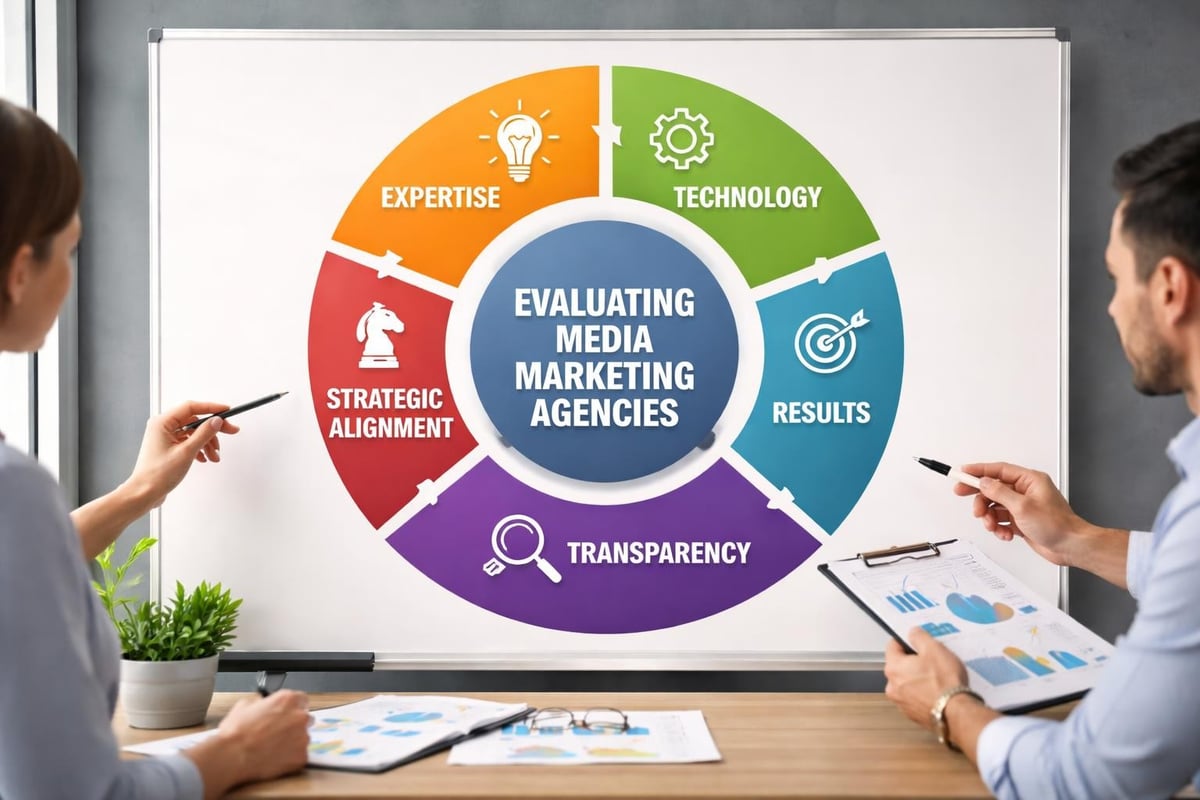
Choosing a media marketing agency requires careful evaluation of capabilities, culture fit, and track record. Not all agencies possess equal expertise across all channels, and the best partnership aligns agency strengths with business needs and growth objectives.
Essential Evaluation Criteria
Begin by assessing the agency's industry experience and client portfolio. Agencies with relevant sector knowledge bring valuable context about competitive dynamics, audience preferences, and effective messaging strategies. Review case studies that demonstrate measurable results rather than just creative awards or subjective testimonials.
Technical capabilities matter significantly in 2026. The agency should demonstrate proficiency with modern marketing technology stacks, analytics platforms, and automation tools. Ask specific questions about their approach to campaign measurement, attribution modeling, and reporting cadence.
Questions to ask prospective agencies:
- What specific results have you achieved for businesses similar to ours?
- How do you approach budget allocation across multiple channels?
- What tools and platforms do you use for campaign management and analytics?
- How frequently will we receive performance reports and strategic recommendations?
- What level of transparency do you provide into media buys and vendor relationships?
- How do you stay current with platform algorithm changes and industry developments?
Cultural alignment often determines long-term partnership success. The agency team should function as an extension of your business, understanding your values, voice, and vision. Specialists at firms like New Love Marketing & Design emphasize the importance of psychological understanding and strategic alignment that goes beyond tactical execution.
Integration with Broader Marketing Initiatives
A media marketing agency delivers maximum value when integrated seamlessly with other marketing functions. Coordination between paid media campaigns, organic content strategies, email marketing, and sales enablement creates synergistic effects that amplify overall performance.
The most effective approaches treat paid media as one component within a comprehensive marketing ecosystem. For instance, social media advertising should complement organic social strategies, with insights from paid campaigns informing content development and community management. Similarly, search advertising performs best when aligned with search engine optimization efforts.
Cross-Channel Campaign Orchestration
Modern consumers interact with brands across multiple touchpoints before making purchase decisions. A coordinated cross-channel approach ensures consistent messaging while respecting the unique characteristics of each platform.
| Channel | Primary Strength | Best Use Case | Typical Metrics |
|---|---|---|---|
| Search Ads | High purchase intent | Capturing demand from active searchers | CPC, Conversion rate, Quality score |
| Social Media | Audience targeting precision | Building awareness and engagement | CPM, Engagement rate, Reach |
| Display Advertising | Visual storytelling | Retargeting and brand building | Viewability, CTR, Brand lift |
| Video/Streaming | Emotional connection | Product demonstration and storytelling | Completion rate, VTR, Brand recall |
Agencies specializing in digital marketing across diverse industries understand how to sequence touchpoints strategically, moving prospects through awareness, consideration, and decision stages efficiently.
Measuring Success and Optimizing Performance
The relationship with a media marketing agency should be characterized by transparent performance measurement and continuous improvement. Establishing clear key performance indicators (KPIs) at the outset creates accountability and provides benchmarks for evaluating campaign effectiveness.
Different business objectives require different measurement frameworks. A company focused on brand awareness prioritizes reach, frequency, and aided recall metrics. A direct-response business emphasizes cost per acquisition, conversion rates, and return on ad spend. Many organizations balance both approaches, investing in upper-funnel awareness while maintaining lower-funnel conversion campaigns.
Performance Optimization Cycles
Top-performing agencies implement regular optimization cycles that review performance data, identify improvement opportunities, and execute refinements. This iterative approach typically operates on weekly or bi-weekly intervals for active campaigns, with more comprehensive strategic reviews occurring quarterly.
Standard optimization process:
- Data collection and analysis: Gather performance metrics across all active channels and campaigns
- Pattern identification: Recognize trends, anomalies, and opportunities in the data
- Hypothesis development: Formulate testable theories about potential improvements
- Implementation: Execute changes to targeting, creative, bidding, or channel mix
- Validation: Measure the impact of changes and determine next steps
This scientific approach to campaign management minimizes wasted spend while maximizing results. Businesses working with specialized online advertising agencies benefit from this disciplined methodology that treats marketing as an investment requiring constant refinement.
Emerging Opportunities in Specialized Media
The fragmentation of media consumption creates opportunities for businesses willing to explore emerging channels and formats. While mainstream platforms like Google and Facebook dominate advertising budgets, underutilized channels often deliver exceptional returns for early adopters.
Podcast advertising has matured into a substantial opportunity, with listeners demonstrating high engagement and recall rates. Audio streaming platforms like Spotify offer sophisticated targeting capabilities that rival traditional digital channels. Connected TV platforms provide the reach of television with the targeting precision of digital advertising.
The Creator Economy Revolution
Perhaps no trend has disrupted traditional media planning more significantly than the creator economy. Individual content creators now command audiences that rival major media properties, and consulting agencies are emerging to help navigate this space. Authentic partnerships with relevant creators often outperform traditional celebrity endorsements at a fraction of the cost.
A forward-thinking media marketing agency maintains relationships with creator networks and platforms, facilitating partnerships that align with brand values and target audiences. These collaborations range from sponsored content integrations to long-term brand ambassador relationships.

Building Long-Term Agency Relationships
The most successful agency partnerships evolve into true strategic collaborations rather than transactional vendor relationships. This transformation requires investment from both parties in communication, trust-building, and shared goal alignment.
Regular communication cadences establish rhythm and accountability. Weekly status updates keep all parties informed about campaign performance and upcoming initiatives. Monthly strategic sessions provide space for deeper analysis and planning. Quarterly business reviews assess progress toward annual objectives and adjust strategies as market conditions evolve.
Transparency and Trust
Transparency forms the foundation of productive agency relationships. Agencies should provide clear visibility into media spending, vendor relationships, and the rationale behind strategic recommendations. Businesses, in turn, must share relevant information about sales performance, market feedback, and strategic priorities that inform campaign planning.
The best partnerships feature open discussions about what's working and what isn't. When campaigns underperform, collaborative problem-solving produces better outcomes than blame assignment. Similarly, when campaigns exceed expectations, joint analysis identifies the success factors for replication.
Resources like industry publications focusing on marketing trends help both agencies and clients stay informed about evolving best practices and emerging opportunities. Shared learning accelerates performance improvement and strengthens the partnership.
Investment Considerations and Budget Planning
Determining appropriate investment levels for media marketing requires balancing growth objectives with financial constraints. While no universal formula exists, industry benchmarks and historical performance data provide useful starting points for budget development.
Most businesses allocate between 5% and 12% of revenue to total marketing activities, with media spending representing a significant portion of that investment. High-growth companies or those entering new markets often invest more aggressively, while established businesses with strong market positions may spend conservatively.
Budget allocation framework:
- Testing allocation (10-15%): Experimental campaigns in new channels or with new messaging
- Core channels (60-70%): Proven platforms delivering consistent results
- Seasonal amplification (15-20%): Additional investment during peak demand periods
- Reserve fund (5-10%): Flexible budget for unexpected opportunities or market responses
Working with agencies that understand profit acceleration strategies helps businesses optimize spending across both customer acquisition and retention initiatives. The goal is sustainable growth rather than unsustainable spending that depletes resources without building durable competitive advantages.
Agency Models and Compensation Structures
Media marketing agencies typically operate under several compensation models, each with distinct advantages and considerations. Understanding these structures helps businesses select arrangements that align incentives and promote partnership success.
The traditional commission model compensates agencies with a percentage of media spend, typically 10-15%. This approach simplifies billing but may create misaligned incentives, as agencies benefit from increased spending regardless of performance. The fee-based model establishes fixed monthly retainers for defined scopes of work, providing cost predictability but potentially limiting flexibility.
| Model Type | Structure | Best For | Potential Drawbacks |
|---|---|---|---|
| Commission-based | Percentage of media spend | Large media budgets | May incentivize higher spending |
| Fixed retainer | Monthly fee for services | Predictable budgeting | May limit scope flexibility |
| Performance-based | Compensation tied to results | Results-focused partnerships | Requires clear metrics definition |
| Hybrid | Combination of above | Complex engagements | Can become complicated to administer |
Performance-based compensation ties agency earnings to specific business outcomes like leads generated, sales closed, or return on ad spend achieved. This model aligns incentives powerfully but requires sophisticated tracking systems and clearly defined success metrics. Many agencies now propose hybrid models combining base retainers with performance bonuses, balancing stability with outcome orientation.
Technology and Tool Integration
Modern media marketing agencies leverage sophisticated technology stacks that encompass campaign management platforms, analytics tools, creative development software, and automation systems. Understanding an agency's technological capabilities provides insight into their operational sophistication and ability to deliver results efficiently.
Essential technology categories:
- Demand-side platforms (DSPs): Enable programmatic ad buying across multiple exchanges
- Analytics and attribution platforms: Track performance and assign credit to marketing touchpoints
- Social media management tools: Schedule, publish, and monitor social content and advertising
- Customer relationship management (CRM) systems: Connect marketing activities to sales outcomes
- Tag management systems: Implement tracking codes and maintain measurement infrastructure
- Creative automation tools: Enable rapid production and testing of advertising variations
Agencies investing heavily in technology infrastructure typically deliver more efficient campaign management and more sophisticated optimization capabilities. However, technology alone doesn't guarantee success. The expertise to interpret data and make strategic decisions remains fundamentally human.
Partnerships with specialists offering comprehensive content marketing services often complement media buying expertise, creating integrated approaches that align paid promotion with organic content strategies.
Industry Specialization and Vertical Expertise
While full-service agencies maintain broad capabilities, specialized agencies focusing on specific industries often deliver superior results through deep vertical knowledge. Healthcare marketing differs fundamentally from retail promotion, which bears little resemblance to B2B technology marketing. Regulatory constraints, buyer behavior patterns, and effective messaging strategies vary dramatically across industries.
Agencies with healthcare expertise understand HIPAA compliance requirements and the complex decision-making processes involving multiple stakeholders. Those specializing in professional services recognize the importance of thought leadership positioning and relationship-building over aggressive promotional tactics. Retail-focused agencies excel at seasonal campaign planning and promotional mechanics that drive immediate purchase behavior.
When evaluating agencies, consider their experience within your specific industry. Review case studies demonstrating familiarity with your competitive landscape, regulatory environment, and typical customer journey. Agencies proven in sectors like healthcare provide valuable expertise for practices exploring specialized digital marketing approaches.
Strategic media marketing requires expertise, technology, and continuous optimization that most businesses cannot efficiently develop internally. Whether you're launching your first paid campaign or optimizing an established media strategy, partnering with specialists who understand the evolving landscape delivers measurable competitive advantages. Mountain Mover Coaching and Digital Marketing combines media marketing expertise with business coaching and profit acceleration strategies to help companies achieve sustainable growth through data-driven campaigns and strategic execution.