
The landscape of business growth has fundamentally shifted over the past decade, with digital marketing and strategy now serving as the primary driver of revenue for companies across all industries. Organizations that master the integration of multiple digital channels, data-driven decision-making, and customer-centric approaches consistently outperform competitors who rely on traditional marketing methods alone. Understanding how to build a cohesive digital marketing and strategy framework requires both technical expertise and strategic thinking that aligns with specific business objectives and target audience behaviors.
Building a Foundation for Digital Marketing Success
Creating an effective digital marketing and strategy approach starts with understanding your business objectives and translating them into measurable digital outcomes. Too many organizations jump directly into tactics-launching social media campaigns or building websites-without first establishing clear goals, key performance indicators, and audience personas.
The most successful digital strategies begin with comprehensive market research. This includes analyzing competitor positioning, identifying gaps in the marketplace, and understanding where your target audience spends their time online. Market intelligence forms the bedrock of every decision that follows, from channel selection to content creation and budget allocation.
Defining Your Strategic Framework
A robust strategic framework includes several critical components that work together harmoniously:
- Clear business objectives tied to revenue, market share, or customer acquisition
- Audience segmentation based on demographics, behaviors, and pain points
- Channel selection aligned with where your audience actively engages
- Content strategy that addresses customer journey stages
- Measurement protocols that track progress toward goals
- Budget allocation that prioritizes high-ROI activities
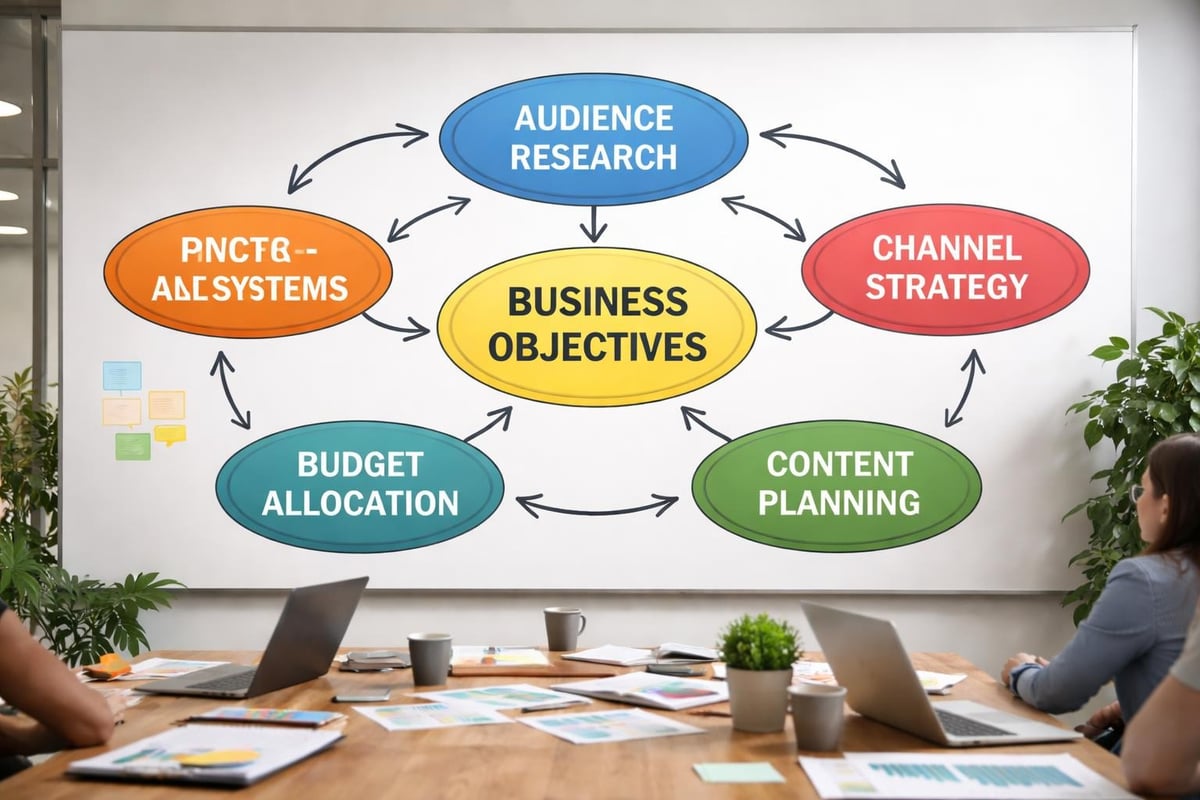
When developing digital marketing strategies, businesses must recognize that success rarely comes from a single tactic. Instead, it emerges from the synergy between multiple channels working in concert to guide prospects through awareness, consideration, and conversion stages.
Content Marketing as Your Strategic Cornerstone
Content serves as the fuel that powers every aspect of digital marketing and strategy. Whether you're optimizing for search engines, engaging audiences on social media, or nurturing email subscribers, quality content remains the common denominator that determines success or failure.
The challenge lies not in creating content, but in developing material that demonstrates expertise, builds trust, and provides genuine value to your audience. According to research on building authoritative content, both search engines and human readers prioritize content that showcases expertise and credibility.
Creating Authority Through Thought Leadership
Thought leadership content distinguishes your brand from competitors by showcasing unique insights, original research, and deep industry expertise. Content marketing for thought leadership requires a commitment to delivering value without expecting immediate returns.
Effective thought leadership strategies include:
- Publishing original research and data analysis
- Sharing case studies with measurable outcomes
- Providing frameworks and methodologies others can apply
- Taking informed positions on industry trends
- Creating comprehensive guides that become reference materials
The businesses that invest in thought leadership often find that it creates a compounding effect over time. Each piece of authoritative content builds upon previous work, establishing the organization as a trusted resource within their industry.
| Content Type | Primary Benefit | Time to Impact | Resource Requirement |
|---|---|---|---|
| Blog Articles | SEO & Education | 3-6 months | Moderate |
| Video Content | Engagement & Trust | 1-3 months | High |
| Podcasts | Relationship Building | 6-12 months | Moderate-High |
| Infographics | Shareability | 1-2 months | Moderate |
| Case Studies | Conversion | Immediate | Low-Moderate |
Search Engine Optimization in Modern Digital Strategy
Search engine optimization has evolved far beyond keyword stuffing and link manipulation. Modern SEO represents a holistic approach to making your digital presence discoverable, credible, and valuable to both search engines and human visitors.
Technical SEO ensures that search engines can efficiently crawl, index, and understand your website content. This includes optimizing site speed, implementing proper schema markup, ensuring mobile responsiveness, and maintaining clean site architecture. These foundational elements determine whether your content even has a chance to rank competitively.
On-Page and Off-Page Optimization
On-page optimization focuses on the elements you directly control on your website. This includes strategic keyword placement, internal linking structures, meta descriptions, header tag hierarchy, and image optimization. Each page should target specific search intent while naturally incorporating relevant keywords without forced repetition.
Off-page optimization primarily involves building domain authority through high-quality backlinks from reputable sources. The emphasis has shifted from quantity to quality, with a single link from an authoritative source often providing more value than dozens of low-quality directory links.
Key SEO priorities for 2026:
- Core Web Vitals performance optimization
- Experience, Expertise, Authoritativeness, and Trustworthiness (E-E-A-T) signals
- Voice search optimization for conversational queries
- Local SEO for location-based businesses
- Video content optimization for YouTube and search results
Many specialized service providers, such as those offering online advertising agencies, combine SEO with paid search strategies to maximize visibility across both organic and paid channels.

Social Media Strategy and Community Building
Social media represents more than just another marketing channel-it provides a platform for building genuine relationships with customers, prospects, and industry peers. An effective social media strategy within your broader digital marketing and strategy framework requires understanding platform-specific best practices, audience preferences, and content formats that drive engagement.
Different platforms serve different purposes and attract distinct audience demographics. LinkedIn excels at B2B relationship building and thought leadership, while Instagram and TikTok drive visual storytelling and brand personality. Facebook continues to dominate for community building and targeted advertising, especially for local businesses.
Platform Selection and Content Adaptation
Rather than attempting to maintain a presence on every platform, successful businesses focus their efforts on channels where their target audience actively engages. This focused approach allows for higher-quality content creation and more meaningful community interactions.
Content must be adapted for each platform's unique format and audience expectations. A LinkedIn article might provide in-depth industry analysis, while the same topic could be distilled into a visual infographic for Instagram or a quick tip video for TikTok. Cross-posting identical content across platforms typically results in lower engagement and wasted effort.
Businesses seeking to strengthen their social presence often benefit from partnering with specialists who understand platform algorithms and engagement strategies. Resources like those available at Mountain Mover’s social media hub provide guidance on effective social media management approaches.
Paid Advertising and Performance Marketing
While organic strategies build long-term value, paid advertising provides immediate visibility and precisely targeted reach. The most effective digital marketing and strategy approaches integrate paid and organic efforts, using paid campaigns to accelerate results while organic channels build sustainable traffic.
Pay-per-click advertising through platforms like Google Ads allows businesses to appear at the top of search results for high-intent keywords. Social media advertising enables sophisticated audience targeting based on demographics, interests, behaviors, and even custom audience lists built from existing customer data.
Campaign Structure and Optimization
Successful paid campaigns require careful structure, ongoing optimization, and rigorous testing. Campaign organization should mirror your customer journey, with different ad sets and creative designed for awareness, consideration, and conversion stages.
Essential paid advertising elements:
- Clear conversion tracking and attribution modeling
- A/B testing of ad creative, copy, and landing pages
- Audience segmentation and personalized messaging
- Budget allocation based on performance metrics
- Regular bid adjustments and keyword refinement
For specialized industries like financial services, working with experts such as Ryan Cook’s ad services can provide the industry-specific knowledge required to create compliant, effective advertising campaigns that drive qualified leads.
The key to paid advertising success lies in understanding your customer lifetime value and acceptable cost per acquisition. These metrics determine how aggressively you can bid while maintaining profitability and sustainable growth.
Email Marketing and Marketing Automation
Email remains one of the highest-ROI channels in digital marketing and strategy, delivering an average return of $42 for every dollar spent. However, this performance requires strategic segmentation, personalized messaging, and automated workflows that deliver the right message at the right time.
Marketing automation platforms enable businesses to create sophisticated nurture sequences that guide prospects through the buyer journey. Triggered emails based on specific behaviors-such as downloading a resource, abandoning a cart, or visiting pricing pages-provide timely, relevant communication that moves prospects closer to conversion.
Segmentation and Personalization Strategies
Generic batch-and-blast emails no longer generate meaningful engagement. Modern email marketing relies on detailed segmentation based on demographic data, behavioral signals, purchase history, and engagement patterns. Each segment receives tailored content that addresses their specific needs, challenges, and position in the customer journey.
Personalization extends beyond simply inserting a first name into the subject line. Effective personalization includes dynamic content blocks that change based on recipient characteristics, product recommendations based on browsing history, and sending time optimization based on individual engagement patterns.
| Email Type | Primary Purpose | Typical Open Rate | Best Practice |
|---|---|---|---|
| Welcome Series | Onboarding | 50-60% | Deliver value immediately |
| Newsletter | Engagement | 15-25% | Consistent schedule |
| Promotional | Conversion | 10-20% | Clear, single CTA |
| Abandoned Cart | Recovery | 40-45% | Send within 1 hour |
| Re-engagement | Activation | 12-18% | Compelling incentive |
Analytics, Measurement, and Continuous Improvement
Data-driven decision-making separates successful digital marketing and strategy efforts from those that waste resources on ineffective tactics. Comprehensive analytics provide insights into what's working, what's not, and where opportunities for improvement exist.
Effective measurement requires establishing clear key performance indicators aligned with business objectives. These might include website traffic, conversion rates, customer acquisition cost, lifetime value, engagement metrics, or revenue attribution to specific channels.
Building a Measurement Framework
A robust measurement framework tracks metrics across the entire customer journey, from initial awareness through post-purchase loyalty. This full-funnel visibility enables you to identify bottlenecks, optimize underperforming stages, and allocate resources to the highest-impact activities.
Critical metrics to track consistently:
- Traffic sources and channel performance
- Engagement rates (bounce rate, time on site, pages per session)
- Conversion rates at each funnel stage
- Customer acquisition cost by channel
- Return on ad spend for paid campaigns
- Email deliverability and engagement metrics
- Social media reach, engagement, and sentiment

Regular reporting and analysis sessions should focus not just on what happened, but why it happened and what actions should be taken in response. This continuous improvement mindset, combined with rigorous testing, drives incremental gains that compound over time.
Integration and Orchestration Across Channels
The true power of digital marketing and strategy emerges when individual channels work together synergistically rather than operating in isolation. An integrated approach ensures consistent messaging, coordinated timing, and reinforced brand experience across every customer touchpoint.
Integration begins with centralized planning that maps out how different channels will support each other. A content piece published on your blog becomes the foundation for social media posts, email newsletter features, paid promotion, and video content-each adapted for its specific channel while maintaining consistent core messaging.
Customer data platforms and marketing automation tools enable true cross-channel orchestration. When a prospect downloads a white paper, that action can trigger a nurture email sequence, add them to a retargeting audience for paid ads, and alert sales teams to high-intent prospects-all automatically and in real time.
Whether you're exploring content marketing companies or building capabilities in-house, the goal remains the same: creating seamless experiences that guide prospects from awareness to advocacy while maximizing efficiency and ROI.
Adapting Strategy for Local and Specialized Markets
While digital marketing principles remain consistent across industries, their application must adapt to specific market conditions, competitive landscapes, and customer behaviors. Local businesses, specialized professional services, and niche industries each require tailored approaches that address their unique challenges and opportunities.
Local businesses benefit significantly from location-based optimization, including Google Business Profile management, local citation building, and community engagement. Geographic targeting in paid campaigns ensures budget focuses on reachable audiences, while location-specific content addresses regional concerns and preferences.
Specialized service providers-such as healthcare practitioners, legal professionals, or financial advisors-must navigate industry-specific regulations while building trust and demonstrating expertise. Content strategies for these industries often emphasize educational resources, credential highlighting, and reputation management.
Professional services firms can examine successful approaches through case studies like digital marketing for chiropractors or dentist marketing strategies to understand how digital marketing and strategy adapts to regulated industries with specific compliance requirements.
Emerging Trends Shaping Digital Marketing in 2026
The digital marketing landscape continues evolving rapidly, with emerging technologies and changing consumer behaviors creating new opportunities and challenges. Artificial intelligence now powers everything from content creation to predictive analytics, enabling unprecedented personalization and efficiency.
Voice search optimization grows increasingly important as smart speakers and voice-activated devices become ubiquitous. Conversational search queries require different keyword strategies and content structures compared to traditional text-based searches.
Privacy regulations and the deprecation of third-party cookies force marketers to develop first-party data strategies and privacy-compliant targeting methods. Building direct relationships with customers through email lists, loyalty programs, and owned communities becomes increasingly valuable.
Video content continues its dominance, with short-form video driving engagement on social platforms while long-form educational content builds authority and trust. Live streaming creates authentic connections and real-time engagement opportunities that recorded content cannot replicate.
Sustainability and corporate social responsibility increasingly influence purchase decisions, particularly among younger demographics. Brands that authentically communicate their values and demonstrate positive impact build stronger connections with values-aligned customers.
Understanding these key qualities of digital marketing strategy becomes essential for staying competitive as the landscape evolves. Organizations must balance consistency in core strategic principles with flexibility to adapt tactics as technologies and consumer preferences shift.
Successful digital marketing and strategy requires integrating multiple channels into a cohesive framework that drives measurable business outcomes while adapting to evolving technologies and consumer behaviors. Whether you're building foundational capabilities or optimizing existing efforts, partnering with experienced professionals accelerates results and helps avoid costly mistakes. Mountain Mover Coaching and Digital Marketing specializes in transforming businesses through expert coaching, profit acceleration, and strategic marketing solutions tailored to your specific goals and market conditions. Ready to elevate your digital presence and drive real growth? Let's build a strategy that moves mountains for your business.